↓
 

SiTAR FAcToRY

sitarfactory.be is a casual magazine about sitar making and repair

  • Projects
    • The Solid Body Sitar
    • Hybrid Sitar, a real Guitar Sitar
    • See-Tar, the Plexiglass Sitar
    • New style sitars SAS & SBS
    • Sitar Modifications
    • Restoration Projects
  • Repairs
    • Joint Repair
    • Kunti Repair
    • Kunti Bushing
    • Neck Bend Repair
    • Tarav Mogara Repair
    • Tumba Repair
    • Tabli info
  • Maintenance
    • Body Cleaning
    • Jawari
    • Tools
      • Floor bench vice
      • Gauge Meter
      • String Wire Conversion
    • Tuning
  • Shop
    • SiTAR FAcToRY Shop
    • Sitar Buying Tips
  • About
    • About SiTAR FAcToRY
    • Hari Chand’s atelier
      • Kartar Chand Hari Chand history
      • Kartar Dhiman’s atelier
    • Indian Music Teachers
  • Contact
1 2 >>

Tag Archives: ghodi

Post navigation

1 2 >>

Buddha Systems in Hiren Roy

SiTAR FAcToRY Posted on Thursday, 25 September 2025 by AnandaFriday, 26 September 2025

Buddha SystemsEngineer and passionate sitar player Ashok Nair has been making excellent pickup systems for sitar and other acoustic musical instruments for several years. They are sold under the name Buddha Systems and are now used by many well-known musicians worldwide.

Matyas Wolter is one of them and has been using this transducer for some time. However, Ashok’s pickups are designed to stick to the soundboard of the sitar. A jack plug connection is included and must be attached somewhere on the sitar. This often results in an awkward and inelegant construction. Cables remain visible and the jack plug is then attached to the outside of the tumba or fed through a hole in the soundboard to the inside.

A more attractive solution is to mount the entire Buddha Systems on the inside of the sitar. The pickup is then attached to the underside of the soundboard and the jack connection can be incorporated into the tumba by means of a reinforced hole.

One difficulty is that a good location for the pickup must be determined. The final sound produced by the transducer is highly dependent on the placement of the pickup. If the pickup is mounted on the outside, the location can still be adjusted, but once the pickup is inside, it is no longer so easy to change.
Matyas already had a lot of experience with the pickup (mounted on the outside) and after some searching and testing, we found a suitable location for the pickup and marked it clearly on the outside.

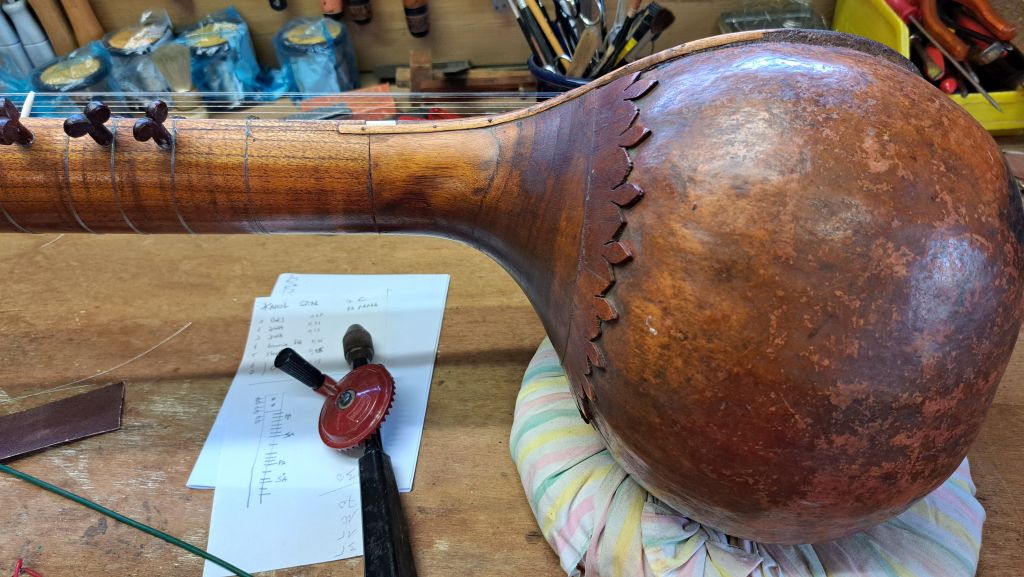
I then opened up the sitar and glued the pickup to the inside at the designated spot using cyanoacrylate gel. This sitar already had a hole in the hard part of the gourd and just below the soundboard block. That is a good and sturdy combination. The tumbas that Hiren Roy has chosen for his instruments are, of course, of excellent quality. They are also reinforced on the inside and made a little denser. The assembly goes smoothly.

Buddha Systems
Buddha Systems
Buddha Systems

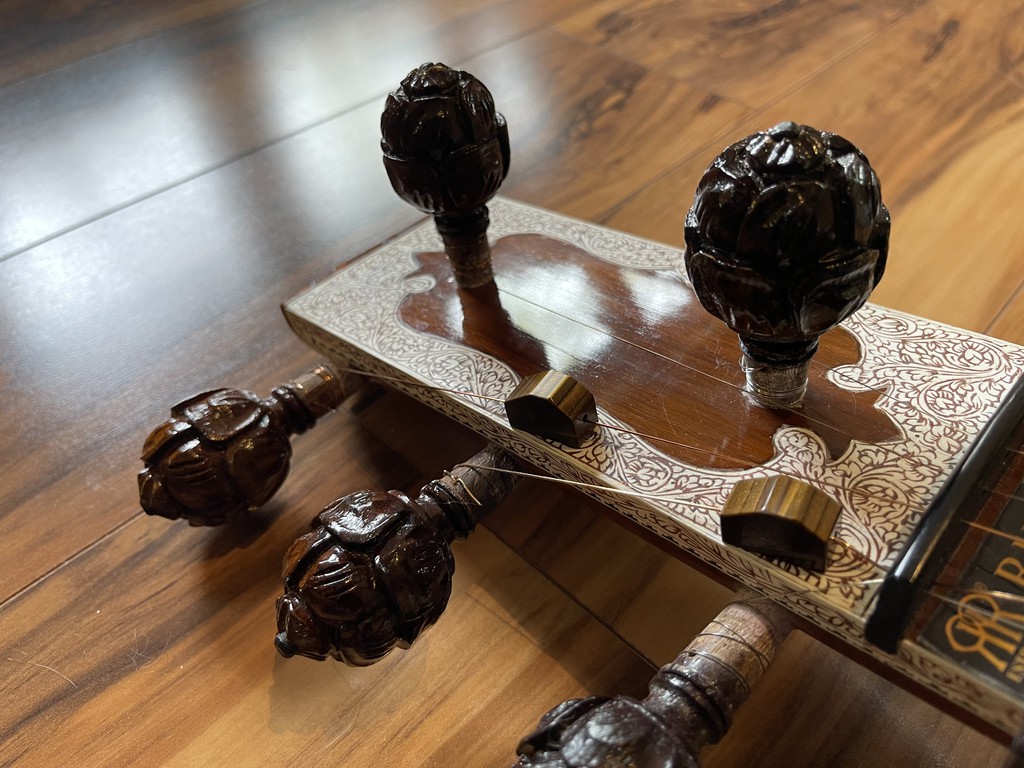
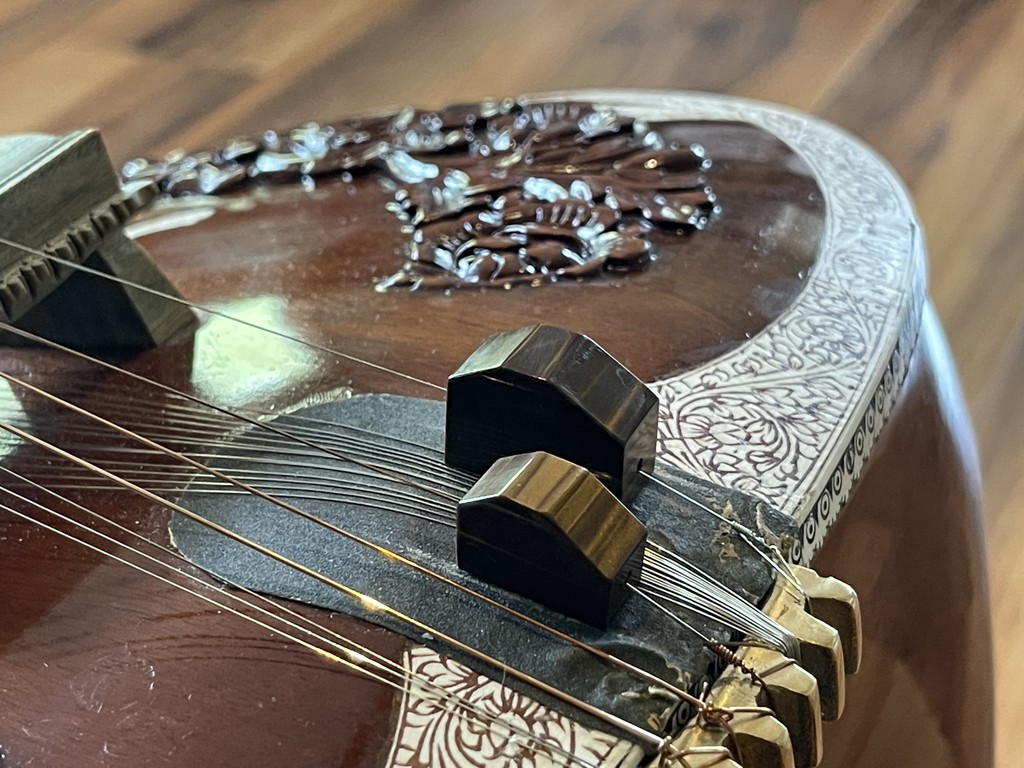
Matyas also takes the opportunity to have another ghodi fitted. I made him a set of new bridges from Black Buffalo horn.

The whole thing gives a nice fresh & modern look to this Hiren Roy sitar, which Matyas mainly uses for his fusion projects. You will certainly be able to hear and admire them soon at one of the upcoming concerts of Pulsar Trio. To be continued… 😉

Posted in playing, varia | Tagged ghodi, Hiren Roy, tabli, transducer | Leave a reply

Kabul 1900 sitar restoration – Pt2

SiTAR FAcToRY Posted on Monday, 12 May 2025 by AnandaThursday, 23 October 2025

In a first part, you can learn about this particular ancient instrument, baptised the Kabul sitar, and read a description of how to check and repair the body and make the missing wooden parts.

Kabul sitar restored

At that time, it was already clear that other important parts were also missing: at least 4 frets had disappeared and, since the intention was to make this a playable instrument again, new bridges also had to be built.

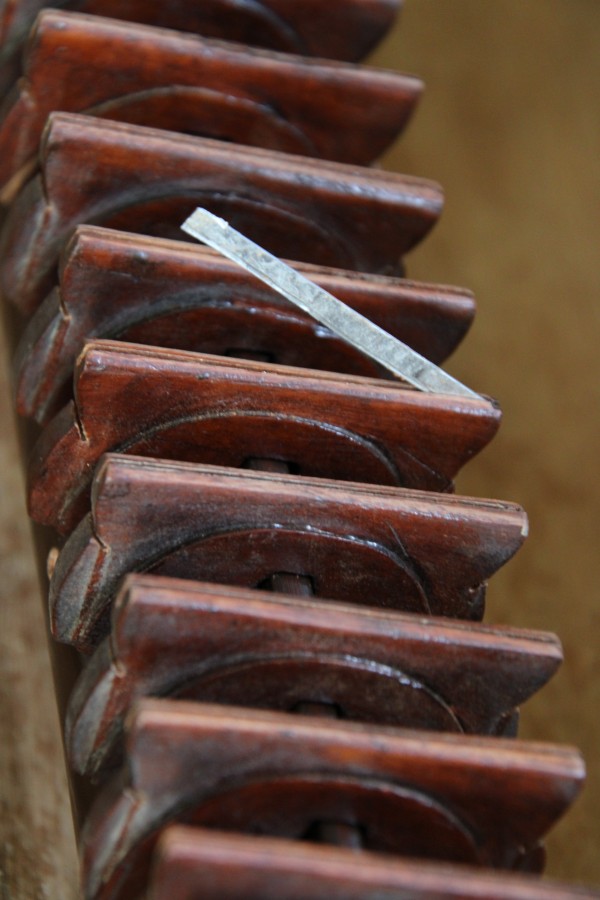
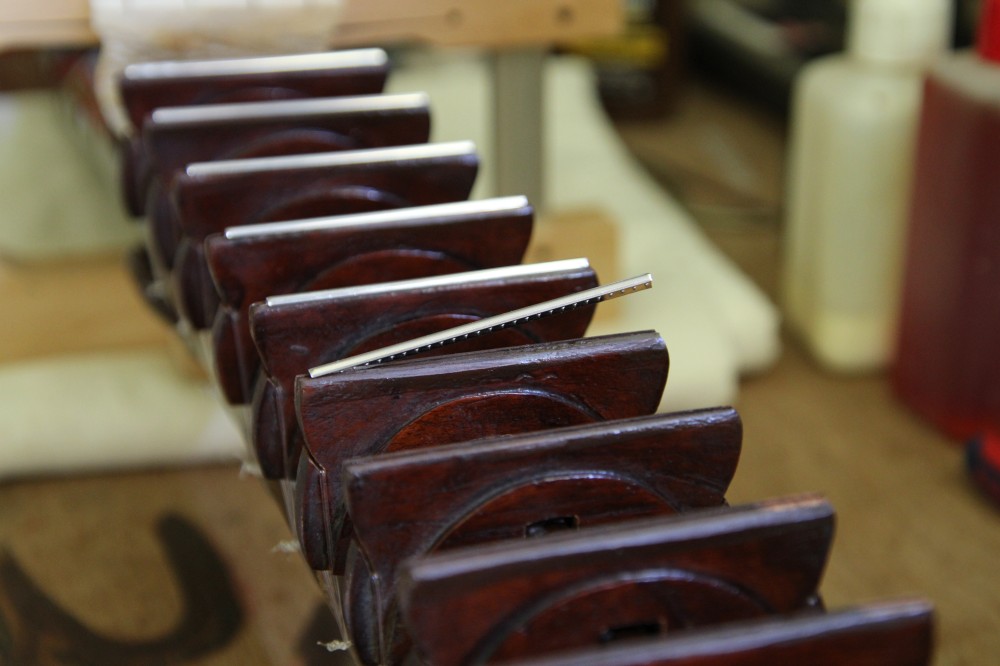
The type of frets used on this old instrument is almost impossible to find anymore. They are flat metal (bronze or brass) strips with a rounded top and 2 gutters on either side of the rounded top. The fixing wires can run into those.

Kabul sitar restored

I don’t know a thing about metalworking. So it was thought to outsource this job to someone else. After some research, Matyas found a German goldsmith who was willing to make 4. This job took a very long time (-1 year) and the result was very disappointing. The material used was very different from the originals and the gutters for attaching the strings were simply unusable. Very unfortunate but back to square one!!!

Around that time, I happened to get to know Kees Verbeek from Eindhoven, the Netherlands. He builds a nice surbahar himself and had a few questions about it. I note on his business card that he is actually also a bronze caster. Assuming that these old frets were made of bronze, I presented Kees with the project and asked him if he could take a look at recreating such frets for us.

Kees was very enthusiastic and I sent him 2 original ones. He immediately set to work. The material eventually turned out to be brass, not bronze, and Kees managed to recreate 4 new ones in no time.

He had a sheet of brass lying around at the right thickness, cut strips out of it and rolled the shape into it. Then he filed in the gutters with fine needle files and finished them seamlessly.

Apart from the fact that they were made recently and thus still have a noticeable new metal sheen, they are barely distinguishable from the originals.

Wonderful work by Kees Verbeek!

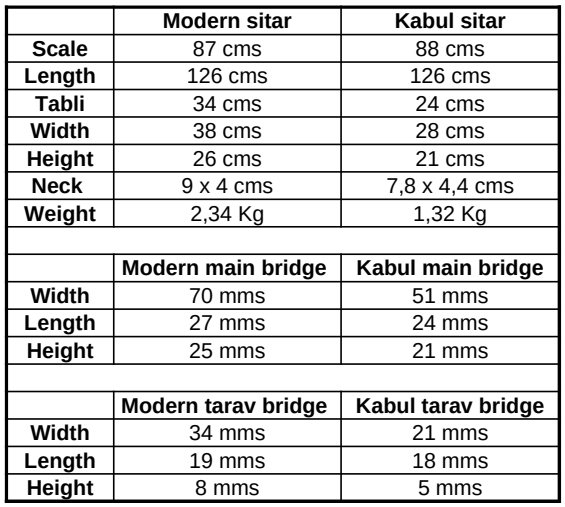
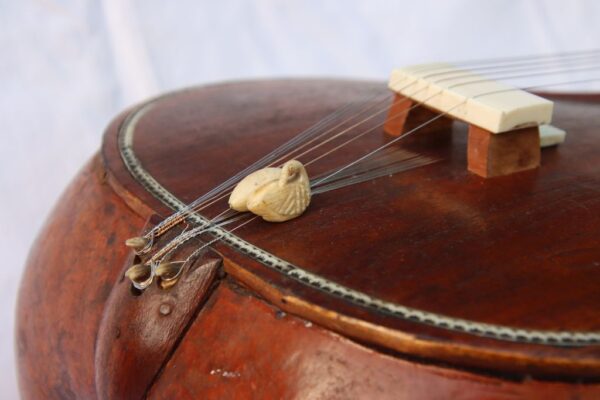
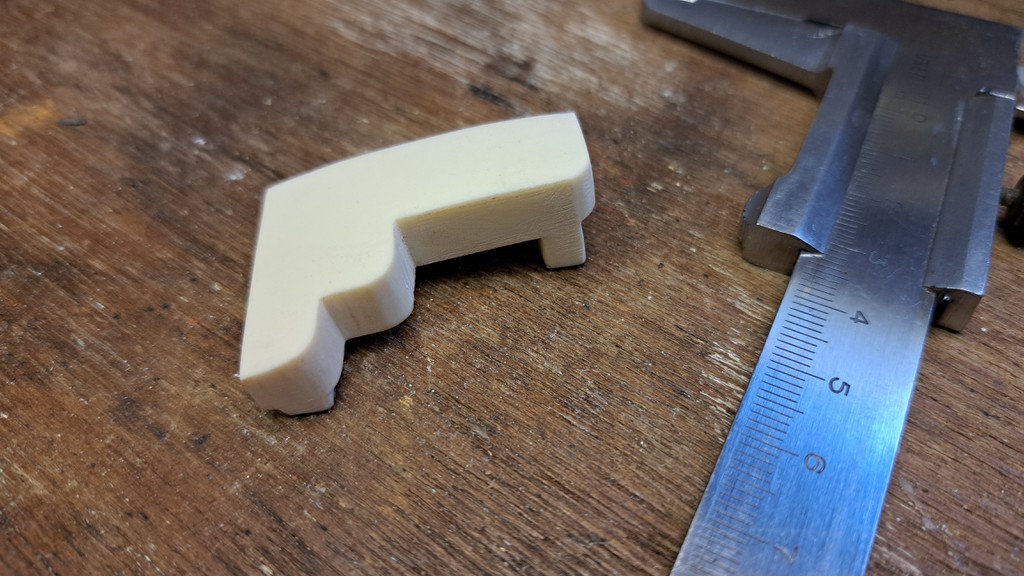
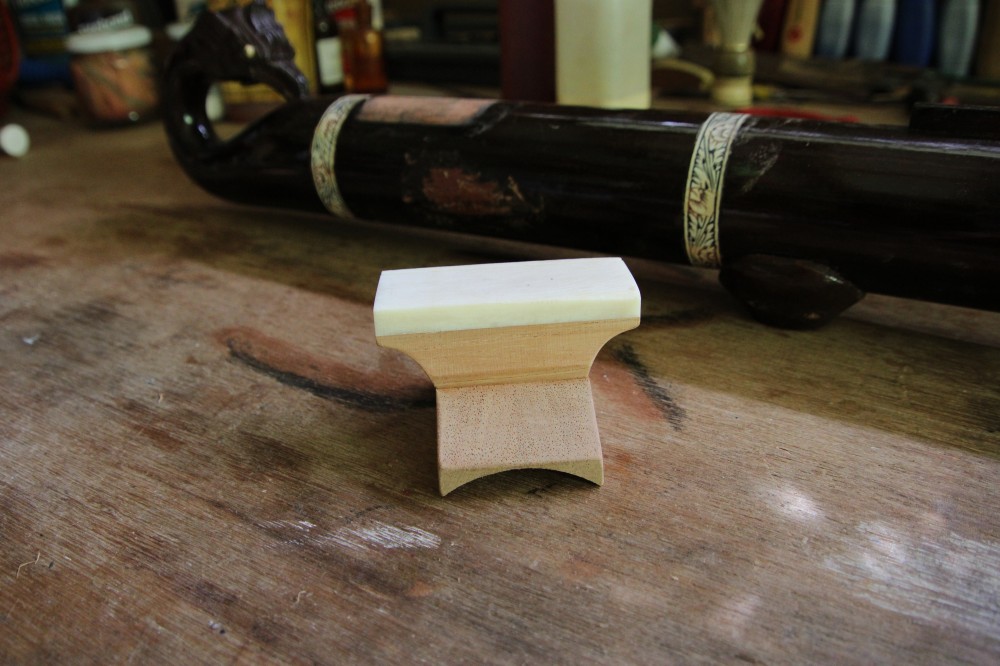
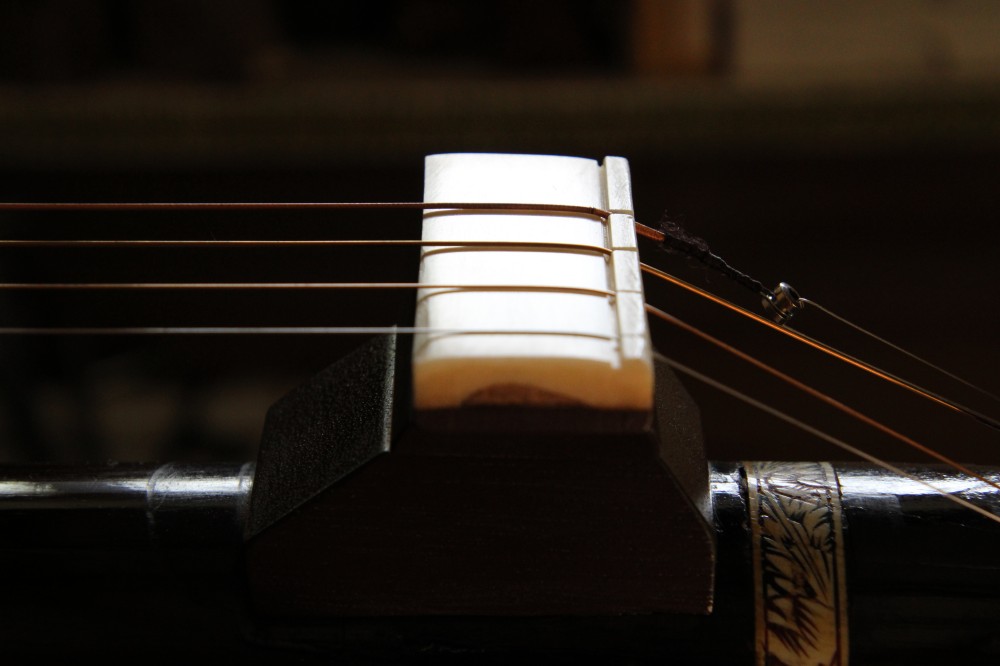
Meanwhile, I made 2 new bridges from first-class quality bone. Or rather bridges, as the instrument does seem quite a bit smaller than an ordinary modern sitar. Although remarkably: the length and the scale have remained almost the same. And, the instrument weighs only 1.32 Kg, which is very little compared to a present-day sitar that easily weighs over 2.34 Kg.

This brings us steadily to the finishing touches. Matyas wants to play it and, as the instrument is very lightly built, we choose a light, thin stringing in a rather low tuning C. For details, see the overview of the Kabul 1900 sitar string set / tuning chart.

Once we agree on these details, I can start fitting the frets. First, I put on a baj string and a jora string. That’s enough to start setting and binding the frets. The position of the frets is determined by the tuning. Little adjustment to the height and position of the bridge is needed to achieve a workable fret distribution. Since this old type of sitar has only 17 frets, the positions for Komal RE, Komal GA and Komal DHA initially remain empty. Even the high Komal NI is not provided permanently.

Once all the frets are in position I check everything again. Finally, the rest of the strings go on. The new Kabul sitar sounds soft and very lively. Matyas will be pleased…

If you would like to see, hear and read more, take a look at the marvellous report on this sitar, which you can find on Matyas’ outstanding website: Antique Kabuli sitar.

Kabul 1900 sitar string set / tuning chart :

1. Baj – steel wire 0,28mm / N°2 tuned to F3
2. Jora – bronze wire 0,37mm / N°28 tuned to C3
3. Jora – bronze wire 0,37mm / N°28 tuned to C3
4. Laraj – bronze wire 0,46mm / N°26 tuned to G3
5. Pancham – steel wire 0,25mm / N°0  tuned to G4
6. Cikari – steel wire 0,19mm / N°000 tuned to C5
7. Cikari – steel wire 0,19mm / N°000 tuned to C6
0. Taravs – steel wire 0,19mm / N°000

Posted in curiosity, repair | Tagged ghodi, parda, Restoration, varisitari | 1 Reply

Intonation blocks

SiTAR FAcToRY Posted on Saturday, 9 November 2024 by AnandaSaturday, 15 March 2025

Intonation on the sitar (& surbahar) is a very complex aspect for players to master due to its unique structure and intricate tuning system. Unlike Western stringed instruments with standardized frets, the sitar’s pardas (frets) are movable, allowing players to adjust the intervals between notes to suit different ragas or tonal structures. This flexibility, while beneficial for musical expression, also creates a challenge in maintaining acceptable intonation. Even slight misplacement of a parda can alter the pitch and compromise the player’s comfort and impact the performance.

Achieving nearly perfect intonation on a sitar & surbahar requires a lot of attention to detail, advanced tuning skills and adjustments. In consultation with Jan van Beek, I designed intonation blocks for his sitar & surbahar. They are made of Elforyn™ and fully tuned to his instruments.

Elforyn™ is a modern synthetic ivory substitute that is very hard-wearing and at the same time easy to work with. Moreover, it has a very natural appearance.

Besides greatly improved intonation, these special blocks have an additional advantage. The distance from the first parda to the meru (comb or nut) increases, making the string longer there. In this way, it becomes possible to play more comfortable and thus more accurate meend on the highest pardas, and especially on the first.

Another case of intonation can be read here.

Posted in lutherie, playing | Tagged ghodi, intonation, SitarMaking, tuning | Leave a reply

Juma Mankas

SiTAR FAcToRY Posted on Friday, 5 May 2023 by AnandaMonday, 9 June 2025

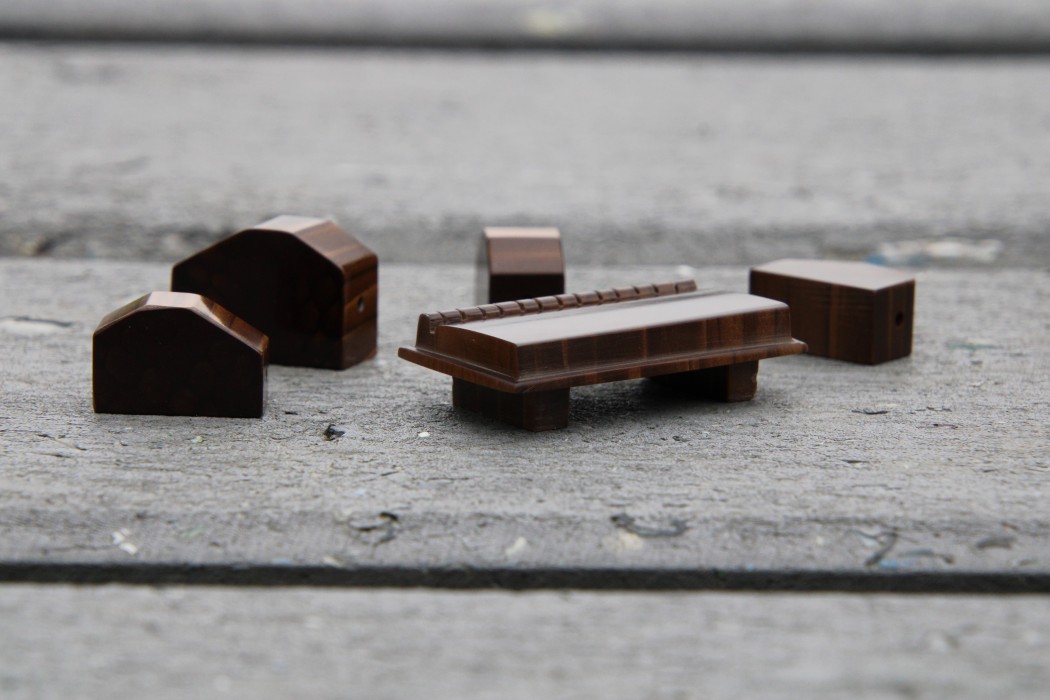
I’ve made a set of mankas and one tarav ghoraj for Zach Ferrara.

They are made out of golden dragon snake Juma® blocs. Juma® – the name stands for independently developed and very modern processing material made from a mixture of various mineral base materials, bound in a resin component. Just like Elforyn® is Juma® excellently suited for the production of components and artistic objects such as knife handles, jewelry, eyeglass frames, or music instrument parts. “Produce your own custom items and delight in genuine one-of-a-kind pieces that no one else will be able to imitate.” the website says.

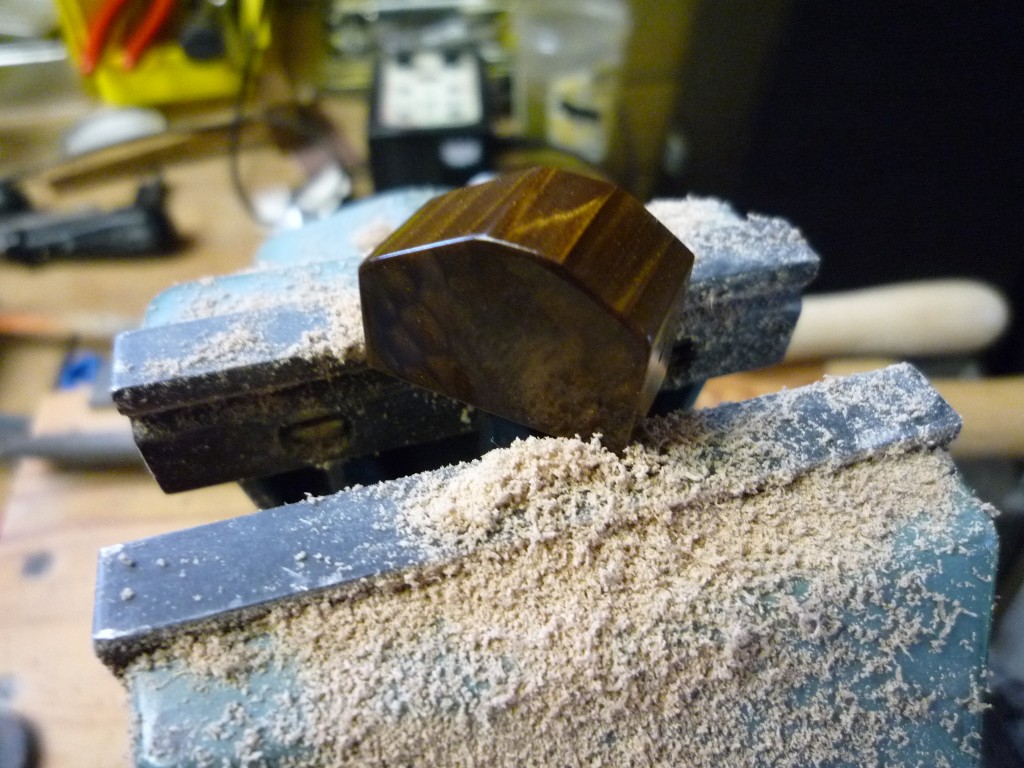
The material is indeed easy to work with and the result feels very natural and pleasant. The optical effect is stunning and has a nice impression of depth. It is definitely very suitable for decorations, mankas and possibly a tarav ghoraj. But I think it has too little resistance to wear to be suitable for a main ghoraj. Elforyn®, on the other hand, does well. Follow this link for Elforyn® examples.

In any case, it looks impressive on Zach’s beautiful sitar. The manka of the main string is made a little bigger than that of the other strings.

Posted in lutherie, making, varia | Tagged ghodi, manka, varisitari | 2 Replies

Rudra Veena repair

SiTAR FAcToRY Posted on Wednesday, 13 July 2022 by AnandaSunday, 16 October 2022

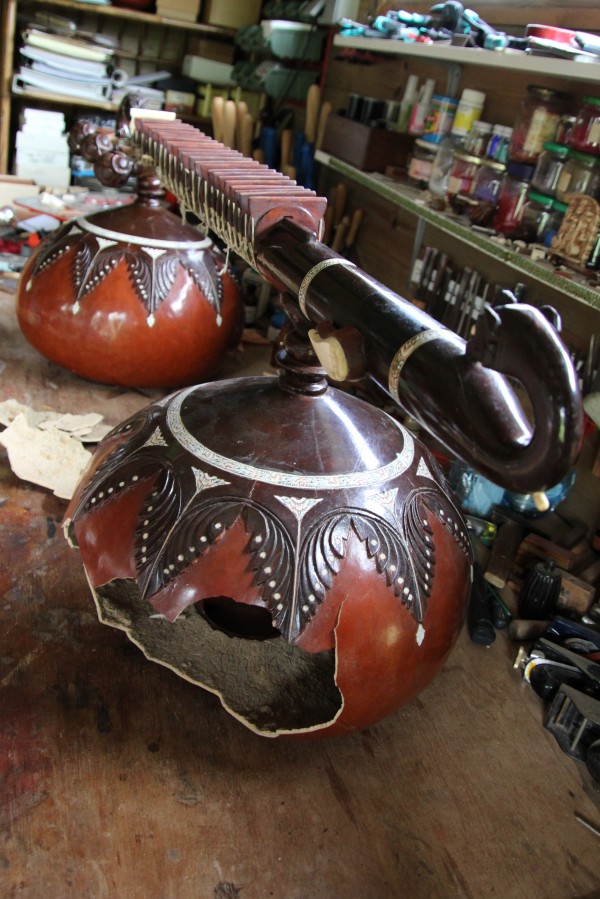
This anonymous rudra veena was found by my friend Guillaume CZLT in Bombay Pekin Bruxelles, a shop for second-hand furniture in Brussels. It was quite badly damaged. One of the tumbas was badly broken, the main bridge had been torn off and lost, and all the frets had been worn away. The fretboard looked more like a pattata field. All the frets were loose and crooked on the neck. A cikari pin was broken… and one day there must have been strings on the instrument…?The work started with repairing the broken tumba. I counted 27 pieces (or small pieces) and 3 appeared to be missing. The puzzle was put back together in 5 stages. Fortunately, everything still fitted well and the transitions are usually smooth. A few coats of varnish over the whole finished this part. Colour matching was not done at this stage.After that, the frets were taken in hand. The old aluminium strips were easily lifted out of the holder. I ordered a set of 24 new pre-cut pieces of fret wire Wagner 9671 Nickel Silver Frets, Large/Jumbo, with dimensions (W x L x H): 70 x 2,75 x 3,2 mm. But first the fret holders all had to be made equal and properly attached to the central guiding shaft. And this one was crooked and irregular too. With a little trick I could get all the frets nicely in one row and fix them firmly in place. After that, I made the top even and flat and finally installed the new frets. That looks good!The last part is the new ghodi. A round base that is glued to the neck gets a nice straight surface. On top of that comes a removable ghodi that is firmly held in place by two metal pins. Quite a construction, but in the end it fits nicely on the whole. Because the upper part is removable, you can easily do jawari at any time. Now all that’s left is to put new strings on it…I think Guillaume will be pleased… 😉
Technical info on strings & tuning according to Asad Ali Khan style:

The scale measures 945cm & the instrument is tuned to G#
Cikari’s: steel 0,30mm (N°3) tuned to G#3 (SA) & G#4 (SA)
Baj tar: steel 0,40mm (N°6) tuned to C#2 (MA)
SA tar: bronze 0,56mm (N°24) tuned to G#2 (SA)
PA tar: bronze 0,72mm (N°22) tuned to D#2 (PA)
Kharaj: flatwound bronze 0,92mm (N°20) tuned to G#1 (SA)
Laraj: bronze 0,56mm (N°24) tuned to G#2 (SA)


For more info about rudra veena you can visit www.rudravina.com and www.rudraveena.org

Posted in repair | Tagged ghodi, parda, SitarRepair, tumba, veena | 1 Reply

Hiren Roy 70’s refurbish

SiTAR FAcToRY Posted on Wednesday, 21 July 2021 by AnandaMonday, 9 June 2025

Hiren Roy 70’s refurbished…

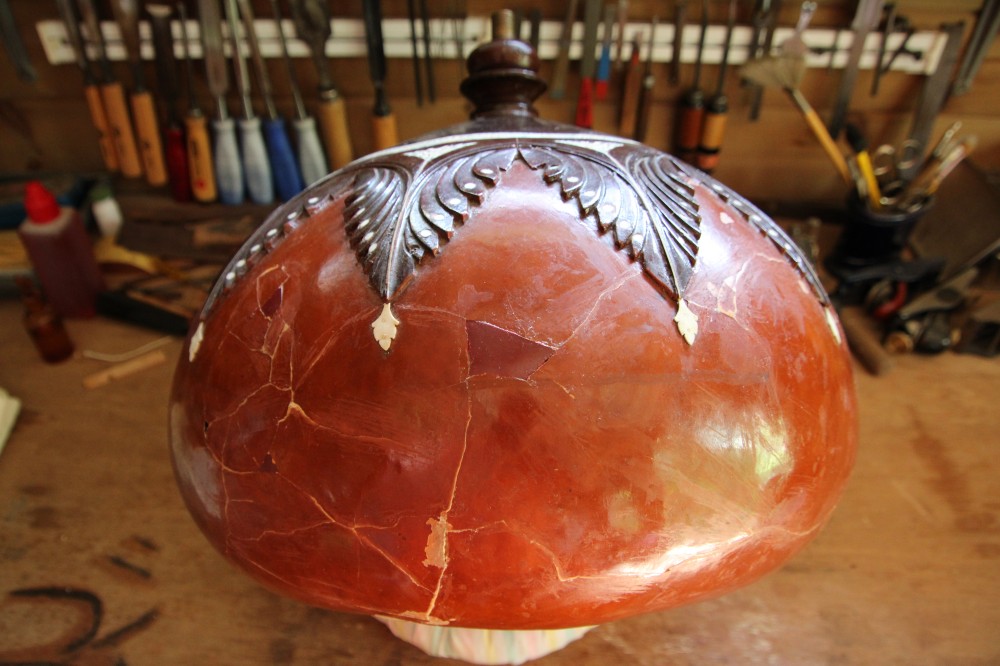
Peeling tumba & crack repair with color change…

before

after

New jawari ghoraj mounted…

Dieter Zarnitz jawari ghoraj with Cumaru top & Angelim Amargoso feet installed.


Pardas added…

Added RE komal & DHA komal, 23 pardas in total.

  • front
  • front tabli
  • tumba
  • front head
  • second tumba
  • front deco
  • tabli
  • ghoraj
Posted in repair, varia | Tagged ghodi, Hiren Roy, parda, Restoration, tumba | 3 Replies

More Dieter Zarnitz ghoraj

SiTAR FAcToRY Posted on Wednesday, 1 November 2017 by AnandaMonday, 17 June 2024

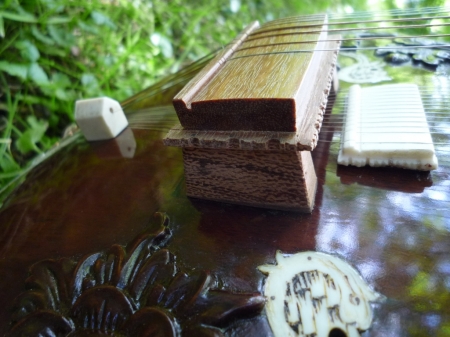
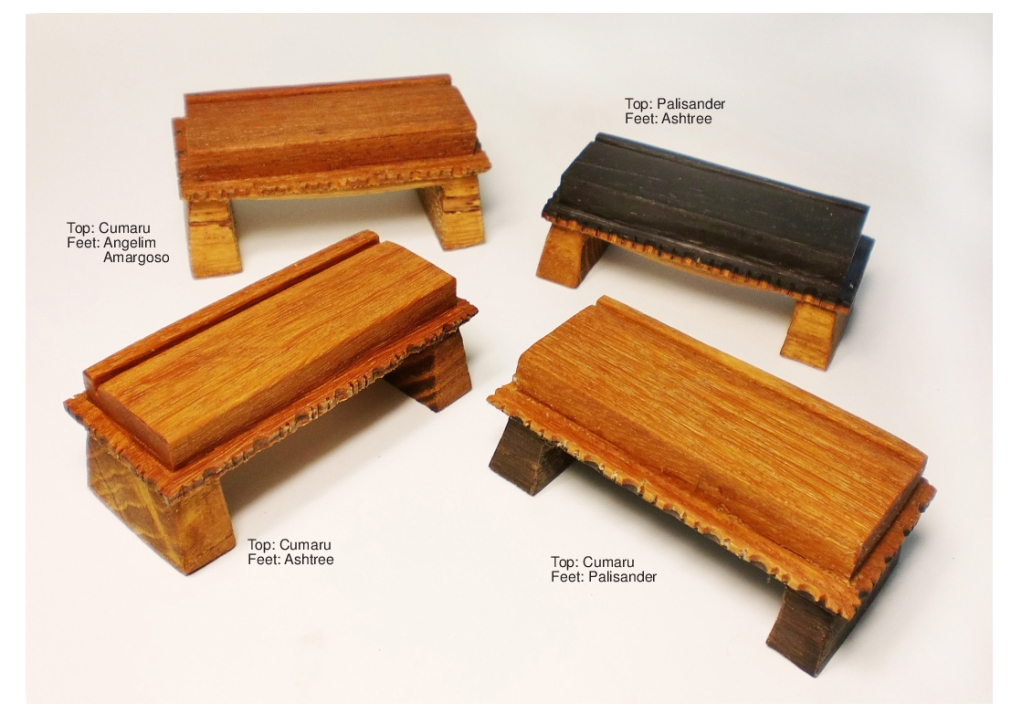
A new set of ghorajs made by Dieter Zarnitz. The wood comes from leftover pieces of a construction.
“Cumaru” is a very fine, hard and durable construction-wood. “Angelim Amargoso” is very heavy and rougher than Cumaru. Both grow in South America. The colour you see is the natural one. The setting (“jawari“) can be done at the Sitar Factory (Belgium).

Posted in making, varia | Tagged ghodi, Jawari | 2 Replies

Dagar Tanpura

SiTAR FAcToRY Posted on Wednesday, 26 August 2015 by AnandaWednesday, 21 July 2021

Ud H. Sayeeduddin Dagar, a great dhrupad singer, cousin uncle from the legendary Dagar brothers, frequently visits Belgium for concerts and teachings. Because travelling with big tanpuras is not easy and not without risk, Dagarji has kept a couple of them here resident for this purpose. Recently, a huge, very old and worn tanpura was in the shop. It was made by famous tanpuramakers from Miraj: Abdul Sattar & Hadji Abdul Karim. There was a minor tumba crack to be repaired and a new jawari to be fitted. The ghoraj, specially made for Dagarji, came as a massive and impressive plain staghorn piece, with a big, very roughly curved surface. Firstly I have made this surface smooth and softly rounded with a coarse file. After that I used soft blocks of upgrading sandpaper to polish the curving perfectly to its final shape.

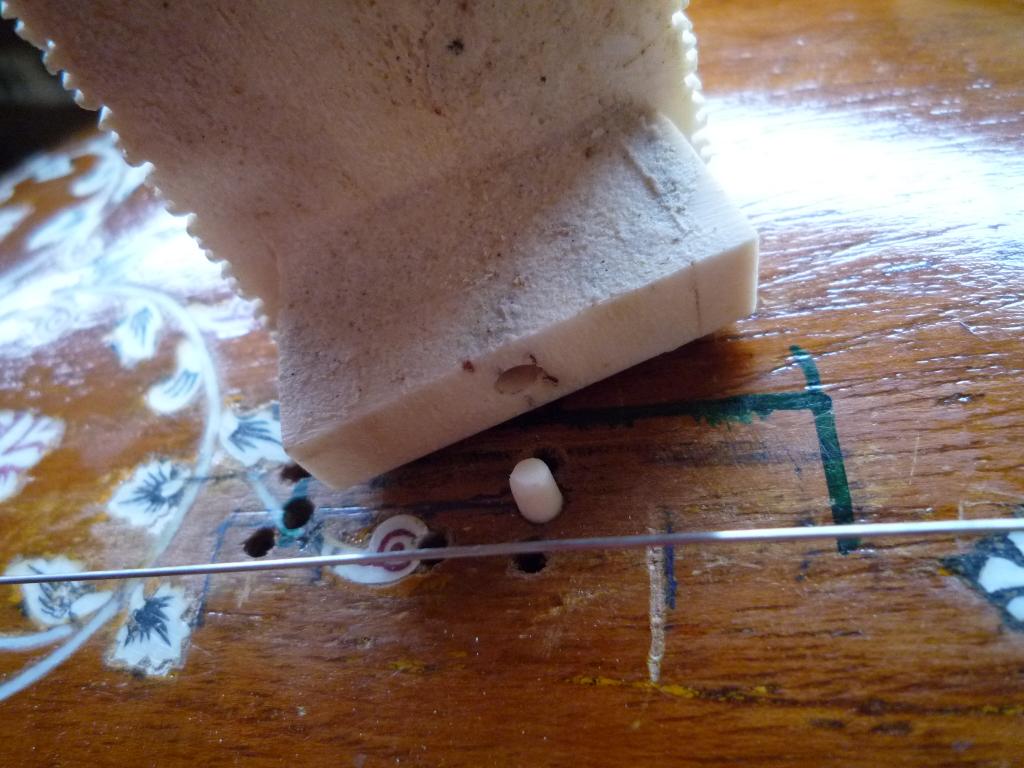
At his request, special thick pins are mounted under the feet to prevent the ghoraj from slipping. Note the amount of holes which were already made in the tabli before. I decided not to make any more other new holes but to use a couple of existing ones.

Sound sample:
Play Tanpura in B-flat

The scale (open string length) of this huge instrument is 96,5cms and it is tuned to B-flat.
The Ud H. Sayeeduddin Dagar custom string set is
1: 0,60mm steel string tuned to E#1
2: 0,60mm steel string tuned to A#2
3: 0,60mm steel string tuned to A#2
4: 0,91mm bronze string tuned to A#1

Posted in listen, maintenance | Tagged Dagar, ghodi, Jawari, Tanpura, tuning | Leave a reply

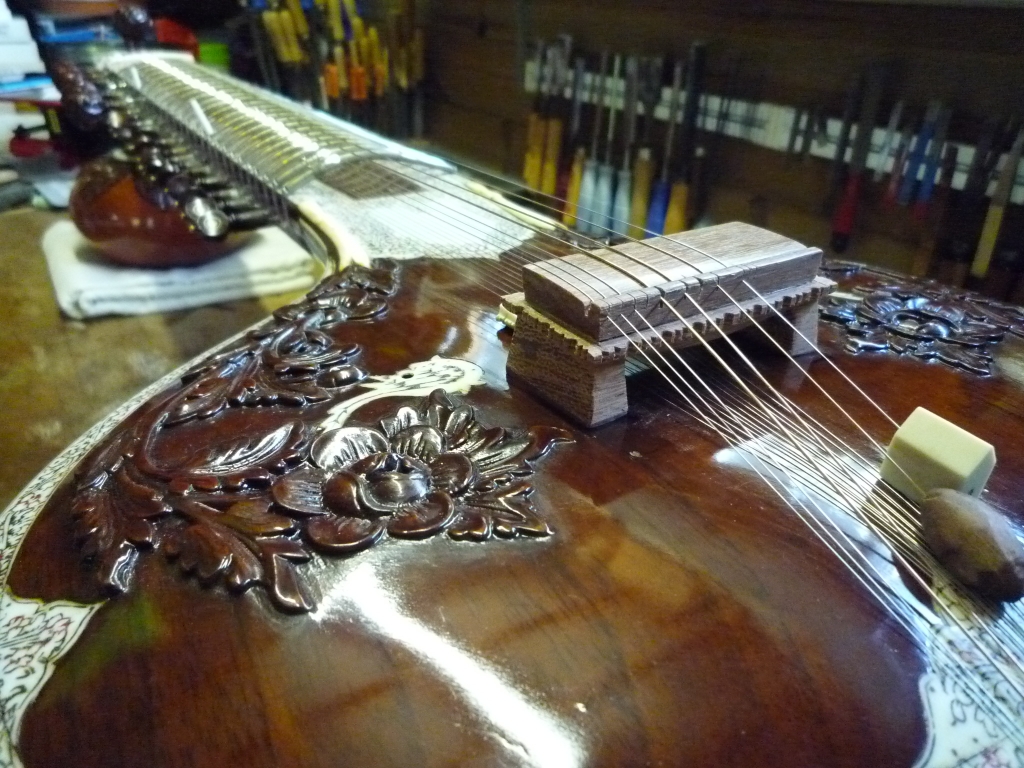
Dieter Zarnitz ghoraj

SiTAR FAcToRY Posted on Saturday, 4 January 2014 by AnandaMonday, 9 June 2025

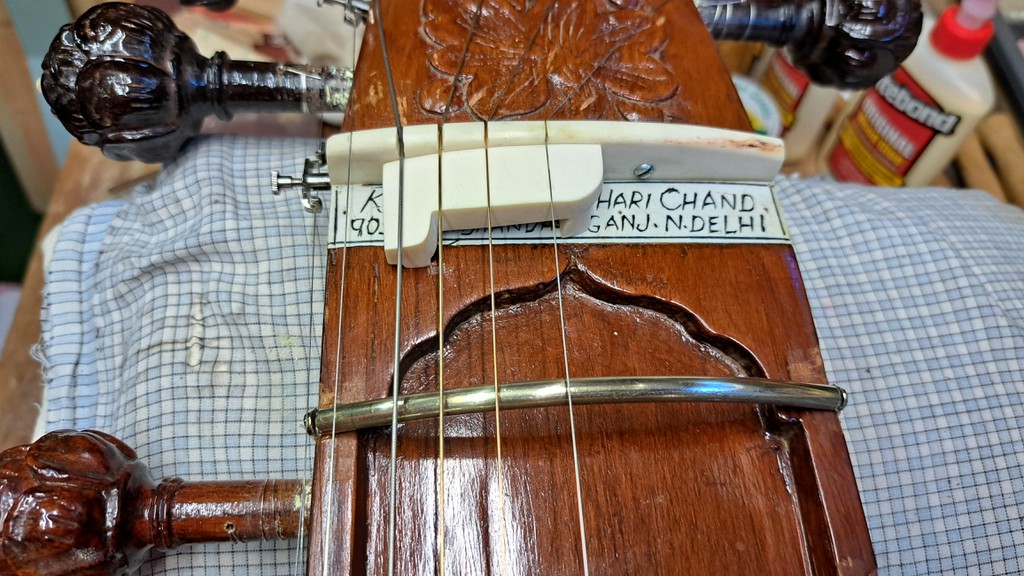
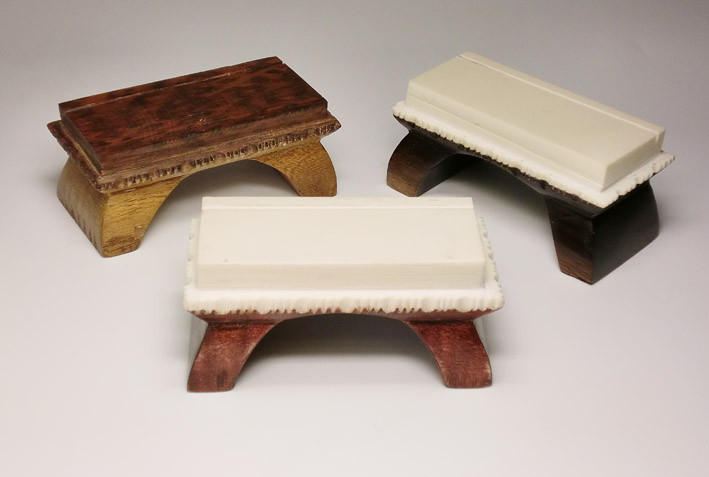
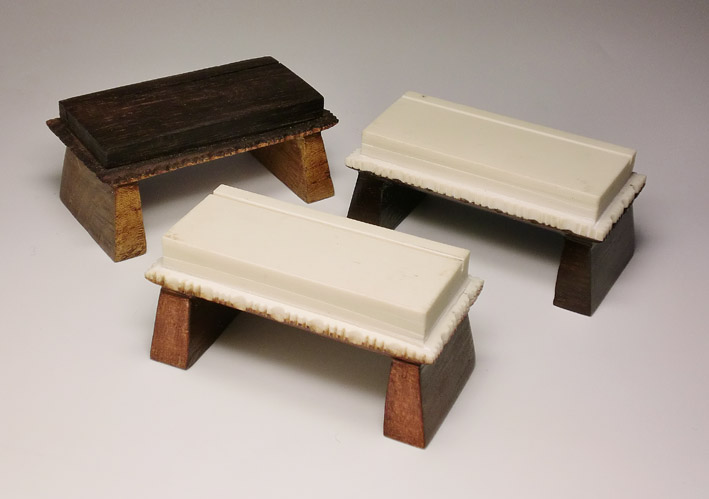
These ghorajs are made by Dieter Zarnitz. He has copied the Barun Roy and Hari Chand style exactly. The feet are from maple or rosewood, the tops out of snakewood, rosewood or Elforyn™. The setting (“jawari“) can be done at the Sitar Factory (Belgium).

Barun Roy
Hari Chand
Posted in making, varia | Tagged ghodi, Jawari | 1 Reply

SAS-01 “Black buffalo” edition

SiTAR FAcToRY Posted on Saturday, 9 November 2013 by AnandaMonday, 9 June 2025

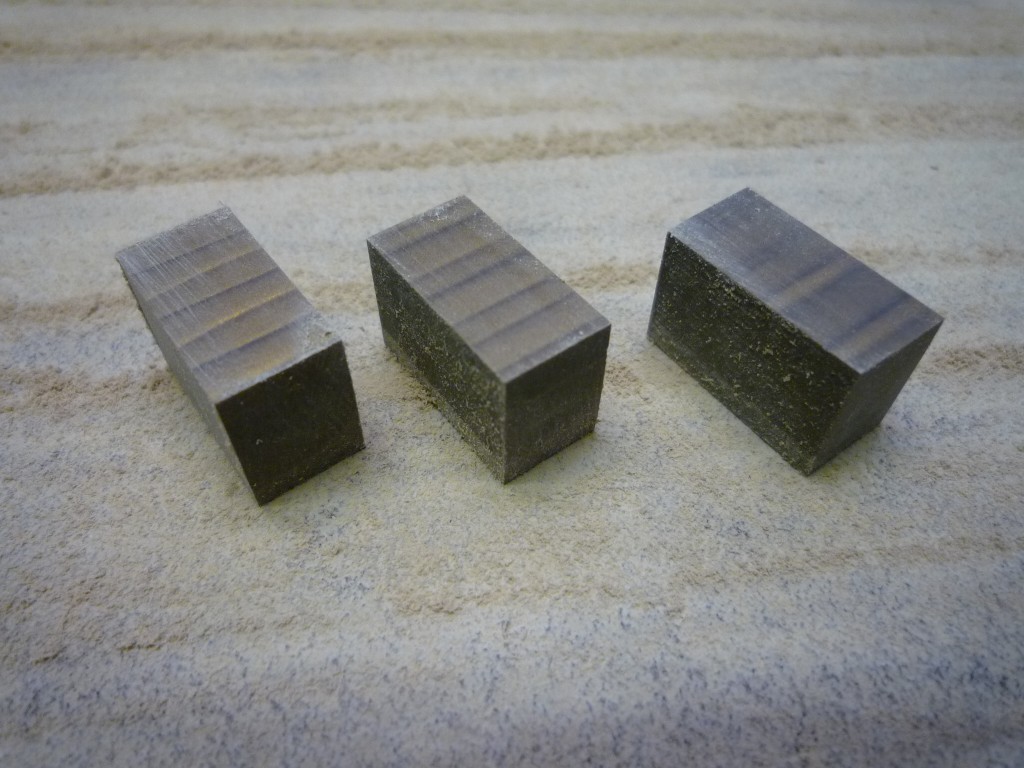
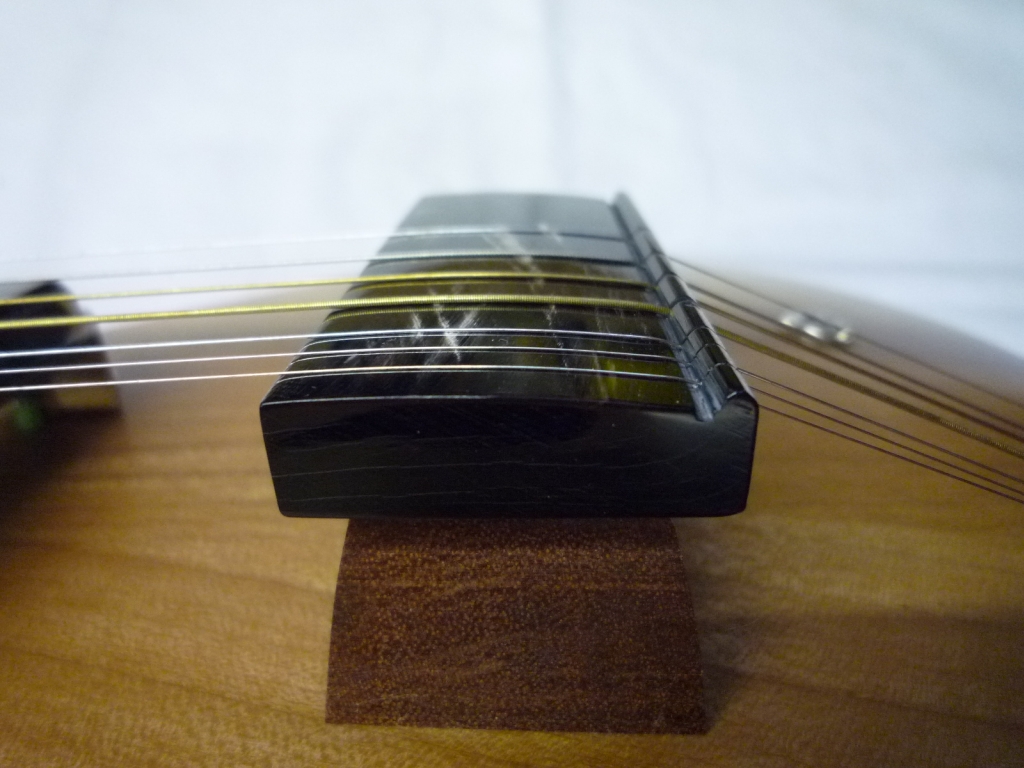
Since the good old stagghorn becomes more and more rare, we are in constant seek for a valid alternative. One of the contenders is the black buffalo horn. Buffalo horn plates are used as material for engraving, for pocket knives, tang blades and japanese cooking knives. The plates are partially covered by bright, natural growth patterns and after polishing it becomes shiny and very durable. The sound is something between stagghorn and ebony. Dense, clear and very warm. Very promising !!

Black buffalo horn plate, as sold at Nordisches Handwerk website.

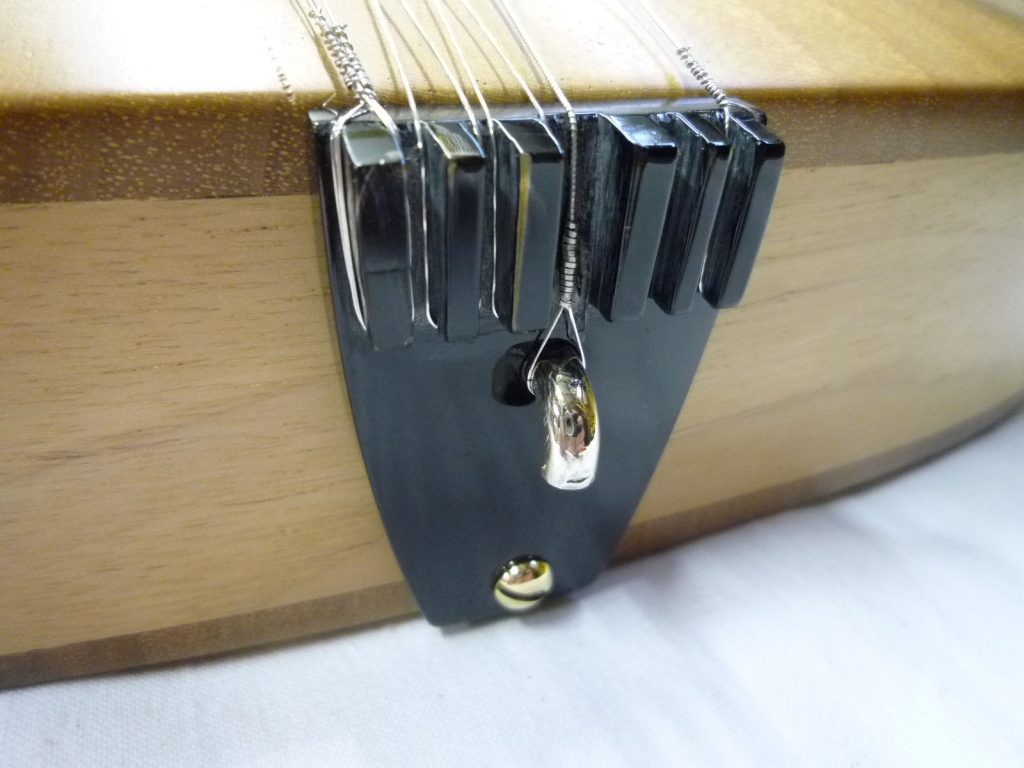
I’ve made a complete new hardware set out of black buffalo horn for my SAS-01 semi-acoustic sitar: ghoraj (main bridge), langoot (tail mount), mogara (cikari posts) and patri (neck bridge). And it looks good !! Click the pictures for fancy-zoom. 🙂


Posted in making | Tagged fusion, ghodi, Jawari, JazzSitar, SAS, SitarMaking | 2 Replies

Post navigation

1 2 >>

Vishwakarma

unloaded picture, try CTRL + F5

FOR SALE @ SITARFACTORY SHOP:

Sitarfactory Sitars for sale

(click here)

OR

other Sitar, Surbahar & Tanpura for sale

(click here)

+++ MUST SEE +++

A photo report about the making of...

A Hybrid Sitar

... the ultimate guitar for sitarists

The See-Tar

... a sitar in plexiglass

The Solid Body Sitar

... a unique combination of ancient and modern know-how.


+++ REVIEWS +++

⭐⭐⭐⭐⭐

Read what others are saying about SiTAR FAcToRY or leave your own review!


Blog Tags

Concerts eco electric ForSale fusion ghodi guitar Hari Chand Hiren Roy India Jawari JazzSitar joint Kanai Lal Kartar Chand kharaj Kunti lutherie Naskar neck parda Pathak plexiglass Raj Musicals Restoration Rikhi Ram Sarod SAS SBS See-Tar Sher Mohammad SitarMaking SitarMods SitarRepair steelstring Surbahar tabli Tanpura tarav transducer tumba tuning varisitari veena Waseem Maner

Categories

Archives

Recent Comments

  • J. Solomon on Electric Zeetar
  • J. Solomon on Electric Zeetar
  • DR SIDDHARTHA CHOUDHURY on Hybrid Sitar, a real Guitar Sitar
  • Ananda on Neck Bend Repair
  • PianoTemmer on Neck Bend Repair
  • harsh on See-Tar, the Plexiglass Sitar
  • Ananda on Alan Arthur Suits

India Soundscapes

Play
Stop
Next»
«Prev
HIDE PLAYLIST
X

Listen to India Soundscapes in popout player


Sitar Makers Links

  • Kartar Chand Dhiman
  • Hans Raj Sharma
  • Naskar & Co
  • Waseem Maner
  • Naeem Naushad
  • Altab Mehboob
  • Ajay Sharma
  • Sanjay Sharma
  • Hari Chand Sharma
  • Hari Chand's shop
  • Green Onion Sitars
  • Alan Arthur Suits
  • Dieter Zarnitz
  • Tony Karasek
  • Jay Scott Hackleman
  • Chandrakantha
  • Vintage Sitars

Lutherie Links

  • CMB
  • MIMF
  • GUL
  • FRETS

Sitar Sale Links

  • Sitarfactory.be
  • Raincitymusic.com
  • India-instruments.de
  • Sitarsencat.com
  • Sitar Buying Tips

Friends Sites

  • ConvergenZ
  • Moviganta
  • Flugzeug Music Art Design
  • Sitar Music
  • Shivoham
  • Music Fund
  • CSA
  • Wervel
  • Low Tech magazine
  • The Meatrix
  • MO
  • Planktone
©2026 - SiTAR FAcToRY Privacy Policy
↑ Scroll