A hiding fracture

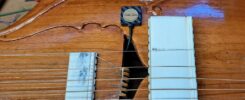
One day, a problem arose with Kees Verbeek’s Hiren Roy surbahar. The instrument had previously been repaired at the headstock. It had probably been dropped or suffered transport damage at some point, but had been repaired very neatly. The instrument had always remained stable, but suddenly the glue joints began to shift and the head became unstable. It went out of tune very quickly, and the glue joints could be felt and seen to move when the head was twisted.
A difficult decision
How should we proceed? Should we let superglue penetrate the joints, loosen the parts and re-glue them, or make a new head? We gave it some careful thought and decided to go for a new head, transferring the ornamental carving.
A major restoration, but then it will be as good as new. After all, it is a precious and very fine surbahar.
“A good instrument is an ongoing organic object – it is never complete,” Kees said earlier in his interview in Meet the Maker – which you can read here on this website…
“The material continues to live and react; you’re never quite finished with it…. but this is a beauty, it’s going to be perfect again. A lovely project,” says Kees, and he gets to work:
The saw goes in

The first step involves loosening the upper saddle and the decoration. Kees wraps the head in a damp cloth and places a light bulb on top to heat it.
After 2 hours of steaming at 35 degrees, the saddle and the decorative ornament come away easily.
Next, the saw goes into the head, and a section just before the second comb is sawn off so you can see how the construction was. Apparently, it’s a pin-and-hole joint.

Then the pin from the head is chiselled out of the neck; it was also secured with five screws. These are sawn off with a loose hacksaw blade and the whole hole is neatly cleaned out.
Ready for the new head…
To do this, a drawing is first made to guide the following steps:

– A scale drawing of the old head in two views, showing the position of the pegs.
– Drawings cut out and the side traced onto a block of old mahogany, with the holes for the pegs also marked out.
– The holes drilled from both sides.
– Side view cut out on the band saw and sanded.
– Top view marked out and cut out on the band saw.
– The entire head sawn through lengthways so it can be hollowed out to the correct thickness later.
– The two parts were sanded and glued back together with paper in between to make them easier to separate again.

Once this is dry, the external surface can be finished and fitted to the neck and also to the dragon’s head. After that, both pins are shaped to fit and fitted to the neck.
The basic shape is in place; now the head can be split again to be hollowed out.
Creative glue clamps

In his enthusiasm, Kees forgot the second saddle. So the decoration needs to be moved up a bit. Fortunately, there’s room for it.
The head is now hollowed out and glued back together. To attach the dragon’s head you have to come up with ‘creative glue clamps’. Kees is very good at that!
He uses ropes around the head and a stick through the hole in the tuning pegs. The tension in the ropes applies sufficient pressure to the joint.
And finally, the new head is completed and in place on the surbahar. After a proper drying time we can move on to the final part: now just to paint and varnish it.
The art of colour matching

Colour matching is incredibly difficult. There always has to be some overlap, and applying shellac changes the intensity.
First, the base colours go on. It’s already looking pretty good. A bit of luck wouldn’t go unwelcome.

Then a first coat of shellac is applied. Kees is already very close. In the photo, you can barely see anything yet. Later, two more coats of shellac follow and then the decoration is put back on.
Finally, the pegs go in and the strings are fitted. Kees Verbeek’s Hiren Roy surbahar is ready!
“Right… that’s all sorted again… glad it’s working properly again,” says Kees.
“Top job!!” I’d say…
Thank you Kees, for sharing this!
A second life for a surbahar