
 A very fragile part of the sitar is the joint. It is the connection between the neck and the resonator. The neck (dandi) itself consists of two large parts: the flat top plate and the round bottom part. The resonator consists of three large parts: the gourd (tumba), the shoulder (gulu) and the top plate (tabli). The shoulder is a wooden part to which the gourd is attached and which serves as a connection to the neck. The shoulder and the neck are connected by a wooden part that is actually an extension of the neck and fits precisely into the shoulder. It is usually a round connection, but it can also be rectangular or trapezoidal. We call this part the joint. It is a crucial part that provides strength and stability to the entire instrument. It also bears the greatest tension of the instrument.
The joint can therefore easily break in an accident or come loose over time when the glue starts to fail. As long as there is no decoration over the junction, this can be easily noticed. Take a good look at the back of your instrument.
Other symptoms include a noticeable increase in action and/or the sympathetic strings starting to touch the first fret. You may also notice that the intonation is no longer correct and that you need to change the position of the frets. Stability in tuning is far gone…
 Now it is the turn of an old and rare Kanailal sitar. The photos speak for themselves…
As always, the work begins with the removal of all hardware: strings, frets, main bridges, tuning pegs, neck bridges and string attachment.


The tabli comes off easily with a well-aimed chisel strike on the glue edge.


 Time to take a good look at the actual joint. I was very surprised to find that this sitar had a different construction. Under normal circumstances, the joint is part of the neck section. The neck & joint are made entirely from a single piece of wood. But in this case, the joint appears to be a single separate piece of wood that is attached to the neck with glue and screws. I have never seen this before… except in the case of a repair where the original joint has been removed or broken off and replaced with a new piece of wood. (see other joint repair)


Because the joint section on the shoulder seems to fit perfectly and be firmly attached, I decide to loosen it on the side of the neck. It is clearly less well fitted and more accessible there. These screws are also firmly attached, but cannot withstand the gentle heat of the soldering iron.
 I get out my steam machine and slide the steam nozzles into the gaps in the neck. Unfortunately, the connecting piece does not come loose. Only after three afternoons of steaming does it start to move. That is not normal either. Usually, this is done in a few hours, but here, warm glue has definitely not been used. More likely, a two-component epoxy-like substance has been used, which I cannot identify, but which indeed glues very hard.
 Now that all the parts are separated, I can see the seriousness of the situation. The two parts of the neck are exceptionally curved and twisted. I fear that the normal repair method will not be sufficient to make it straight and sturdy again.


 From here, we can continue with the “traditional” method. Re-glue the parts, secure them with ropes, and allow the neck section to dry perfectly straight using a sturdy straight wooden beam. There is nothing new under the sun. (see previously neck bend repair)
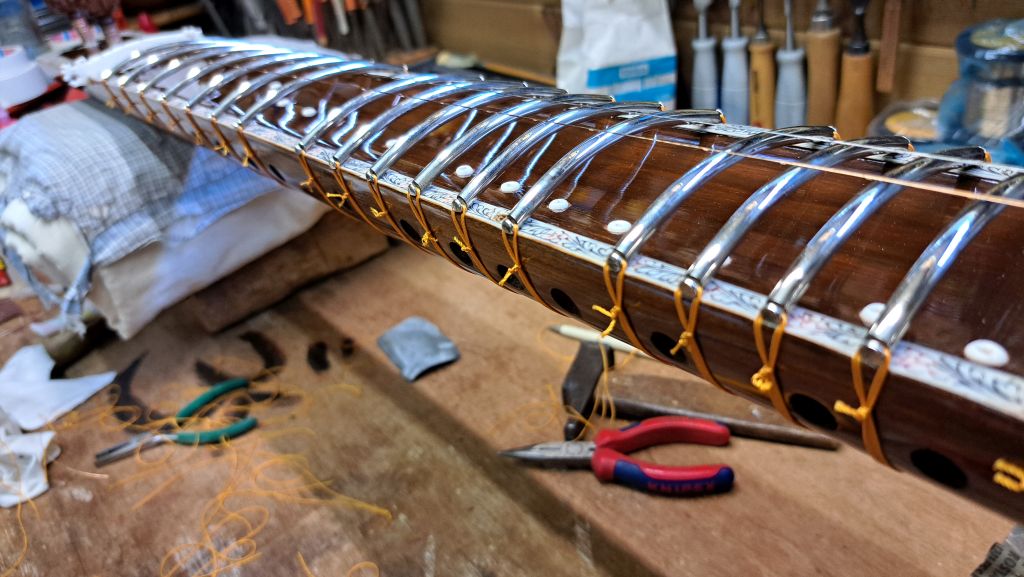 After sufficient drying and curing time, the hardware can be reinstalled: first the decorative strips, followed by a few coats of new shellac finish. Then the tuning pegs, neck bridges and main bridges, frets and finally new strings.
After doing jawari this Kanailal sitar is ready…
 It remains a mystery to me why the joint piece consisted of a single piece of wood and was glued with modern synthetic glue. Could this sitar have had problems with its joint before and was it quickly repaired with this new type of glue? By whom? Who knows? Kanailal, the legend lives on…


