
Talking about a joint here means the connection between two different wooden parts of the instrument: the neck and the body. It is a very important item covering strenght and stability. The body is tilted 4° backwards and 2° downwards according to the neck’s axis. This doesn’t make it more easy.
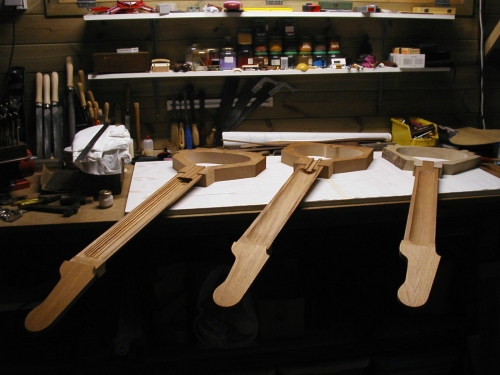
Day 21 & 22: Spending a whole day making a mould to be used for milling the joint.
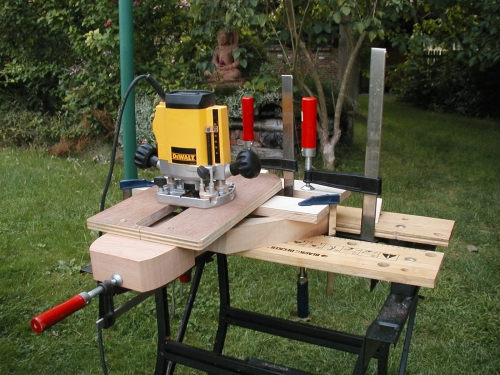
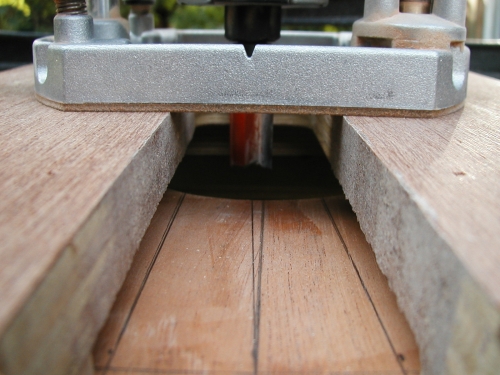
Once this was ready, it was only “a piece of cake” to make the precise cut into the three bodies.
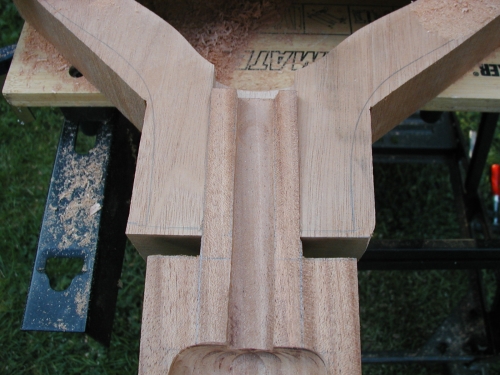
As a prospective builder, what does 4 degrees backwards and 2 degrees downwards mean exactly?
The body is tilted 4° backwards and 2° downwards according to the neck’s axis means that the body-neck joint is not just a straight line. At the joints position there is an angle which measures 4° towards the backside of the instrument. So the neck is tilted 4° towards the backside of the instrument, seen from the body in front. Similar, there is an angle which measures 2° towards the left side of the instrument, seen from the body in front. So the neck is, at the same time, tilted 2° to the left.
I must admit that my initial description was not very clear. I hope this helps ??
Yes that makes much more sense! Just to ensure the relative directions are correct, it is 4 degrees upwards of horizontal as compared to a perfectly straight neck and 2 degrees towards the player’s head as opposed to perfectly straight? Also, thank you for such a quick response!
TAKE CARE: it is 4° degrees DOWNWARDS of horizontal as compared to a perfectly straight neck if the instrument is laying horizontal, thus facing up (strings and tabli up, tumba down)…!! And, indeed, 2° towards the players head as compared to a perfectly straight neck.